


Update: Since launching UX Mastery, this has been the most popular article we’ve published by a country mile. As a result, we’ve turned it into an animated video and published an eBook on the topic.
If you’re after more specific advice, be sure to pick up a copy of our ebook, Get Started in UX, the definitive guide to making a career change and landing a job as a user experience designer.
We’ve received quite a few emails lately from readers looking to get started in UX Design—many coming from a print background. Here’s one such email, which I’ve published here with permission:
I’m a traditional print-based graphic designer looking to get into UX design. I’ve a good background in the Adobe Suite and traditional print software (QuarkXpress etc). Currently I’m working within the newspaper industry and am fearing for my future, as the industry is in (probably) terminal decline. I am looking to re-skill towards web-based UX design. Can you recommend a starting point and path I should look to take? Many thanks.
In our animated video (embedded below) I mentioned that a career as a UX Designer is interesting, challenging, rewarding, pays well, and has a low barrier of entry.
What I didn’t touch on is how to get started as a UX Designer. What follows is my advice for anyone looking to get started in UX Design.
Enjoying this article?
Download the book that it inspired from the UX Mastery store. Available in ePub, mobi and PDF formats.
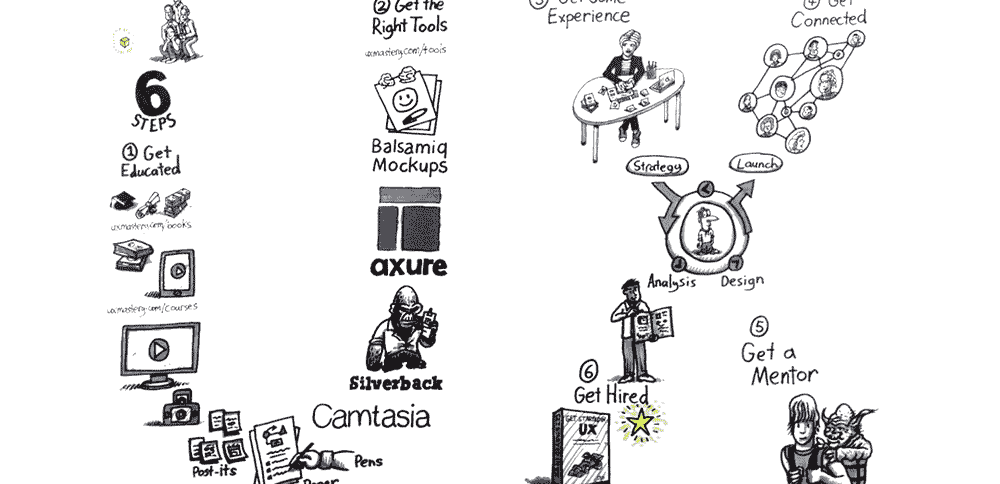
1) Get Educated
I’m not saying you should go invest in a university degree. While I’m certain that there are quality higher education courses out there, I don’t think that’s a necessary step to take to break into the UX world. What I mean is: read, watch and listen to everything you can get your hands on in order to understand how UX Designers do what they do.

We’ve put together a ton of recommended books, which should form a good starting point. If you’re looking for an online course to help you get started, our big list of UX courses is the most comprehensive collection you’ll find. For complete beginners, try Lis Hubert’s UX Basics course or the course Become a UX Designer from Scratch by the Interaction Design Foundation; developers may find Amir Khellar’s Design Your User Experience in 7 Simple Steps more to their liking.
In many of these courses, the subject matter itself isn’t difficult to digest, but there is often a lot to learn. The more you can digest, the better off you’ll be.
2) Get The Right Tools
UX Design is more about working with people than working on your own in front of a screen.
That said, there are two tasks that stand out as being a huge part of what I do: creating interactive wireframes and conducting guerrilla usability testing sessions. Both require software to do properly. I’ve tried a few different applications, but keep coming back to Balsamiq Mockups as my wireframing tool of choice, and I use Silverback (Mac only) for recording my usability testing.
There are plenty of other alternatives to these tools out there; these just happen to be what works best for me. For the most comprehensive list of UX Tools ever, check out our 100+ Awesome Tools For UX Designers.
3) Get Some Experience
Your next step is to find a way to put some of this new-found knowledge into practice. Luckily, it’s possible to do so without having to bluff your way into a job only to discover you’re out of your depth.
Whether it means spending some time after hours helping a friend’s small business, a local non-profit, or a personal project, seek out the opportunity to apply some of the theory, and start getting those runs on the board. It could even be as simple as taking the initiative at work to conduct some user testing sessions, and branching out from there.
Approach an agency or organisation that you have contacts on the inside, and volunteer your time to conduct some usability testing sessions or perform user interviews. While it may go against the grain to admit to being a novice at something (and taking a pay cut to go with that) after you’ve had an established career doing something else, this is a field that is so fast moving that I honestly feel like a year after being “that intern” people would forget that was where you came from, and if you’re adding value then you may be in a good position to renegotiate (or move on to somewhere else that recognises the value you’re adding).
For an activity such as conducting user testing, a handful of sessions is all you need to get the hang of things. Once you’ve introduced that user feedback loop to your project, you can start focussing on developing other skills.
4) Get Connected
The best UX jobs, like all jobs, aren’t advertised. They come through LinkedIn, Twitter, local event meetups, referrals, or are only ever sourced internally. Trusting somebody to own the user experience of a product to somebody, for many organisations, is like trusting them with a newborn baby.
There will be a ton of questions and building trust with the interviewer is key. If the position has come from the result of a conversation in a social setting, or a recommendation from somebody you met, then you’ll already have a head start on building that trust. So get along to your local UX Book Club, find an event on meetup.com, and start following some of the UX thought leaders on Twitter.
5) Get A Mentor
For me, finding a mentor was a real turning point. Even though we don’t catch up as often these days as when we first formalised the mentoring relationship, when I look back now, many of the big decisions I made career-wise happened soon after I found a mentor and he started encouraging me to step out of my comfort zone.
My mentor not only helped shape the process that I use on design projects to this day, he also encouraged me to start giving presentations at conferences and meetups, and to quit the low-paying job that I was in and take control of my career. For that I’m eternally grateful. Finding a mentor can be hard, but hopefully if you’ve done a good job of Step 4, you’ll at least have more people within your circle and a better understanding of who’s who. Hopefully someone will stand out. Failing that, you could try a more formal program such as IAI mentor program or a mentor-led bootcamp like Get a New Job in UX Design by the Interaction Design Foundation.
6) Get Hired
With those ducks all lined up, you’re now in the best possible place to land an awesome job. What’s missing, however, is a portfolio of your work.
Much like a graphic designer would have an A3 portfolio that showcases logos, posters and t-shirts he or she has designed, your portfolio should include examples of the deliverables you’ve produced.
Your portfolio could include wireframes you’ve created, example personas and scenarios you’ve developed, photos of walls covered in post-it notes from affinity diagramming exercises, photos of you conducting a workshop … whatever you need to tell a story about the process you follow, and to help you talk about that process during an interview. If you want help, we recommend the online course called How to Create a UX Portfolio by the Interaction Design Foundation.
Want to hear more? Pick up a copy of our ebook: Get Started in UX.
Where to learn more:
- Recommended UX Books
- See our list of UX Conferences
- Find an Online UX Courses that suits you
- Our giant list of UX Degrees
- The best UX Tools and Software
Related Reading
- Get Started in UX: the complete guide to launching a career in user experience design by Luke Chambers and Matthew Magain
- Whitney Hess’s mind-bogglingly comprehensive collection of resources and guiding principles.
- Patrick Neeman’s list of seven tips on how to get started in user experience
- Nick Finck’s excellent tips on starting a career in user experience design
- UXPin’s collection of free UX books
- A comprehensive (and free) UX course
- A free course on UX Design for mobile developers
- UX Beginner
- UX Apprentice
What other advice do you have for people trying to migrate to UX Design from another career? Let us know in the comments.





Hey Matthew,
Thanks for the tips on getting started in UX. While I have no aspirations to be a UX designer, the entire industry fascinates me. Having a basic understanding of how things should work on the web is always helpful, too.
You’re welcome Michael. Yes it’s a very interesting space to be working in!
Hello Matthew,
Great article as always, a lot of ppl around eager to enter the UX field and you showed them the way.
Thanks .
Happy to help, Ahmad!
Matt,
Always value from your content and posts. Continue with your mission on helping people change their lives. You have been an inspiration to me indeed.
Thanks,
Duke
I’m honoured that you thought so highly of this post Duke! Thanks so much for saying so.
Hi Matthew,
This article really gave me a great understanding of how to put myself out there in helping me attain my goal of becoming a UX Designer. However, I’m finding difficulties finding the right school to help my study this field. Any suggestions? I’m looking somewhere along the East Coast in the NY, NJ, PA area. Thanks again!
Sorry Parker. As I described in my post, my experience does not include attaining a formal education in UX, and I don’t believe it’s necessary to succeed. I’m sure there are some worthwhile courses out there, but I also get the impression that there are plenty of universities whose curriculum is woefully out of date.
You don’t need a degree in UX Design to be a successful UX Designer. You need knowledge, tools, experience and a network.
thanks that is great point i ever seen
Thanks for the info and refresher!
I know from my end, I’ve worked in community management and social media marketing within the video game industry. Although we are not always looked at as specifically user experience, you can’t help but understand how critical those roles are to the end user.
For me, I represented many high-quality and award-winning digital products. My role as simply a community management professional played a vital role with understanding the users who played those products. In return, that knowledge improved the product development before going to market and therefore after. It’s simply amazing how vital user experience is as a science to almost every type of business out there.
Great insights Glen. There is much the UX world can learn from both the gaming industry and community management.
You know I wish I had found this article before I completed my MSc in UX. As you said the university course is completely outdated. Only handful of lecturers are updated with UX, or even technology!
Yeah it’s a shame that some academics can become ensconced in academia and lose track of what is happening in the real world. It happens, unfortunately!
Matt:
My mind was like a monkey in the cage. It did not settle until I watched your video and landed here. I’m interviewing for a UX/UI design position Thursday, to be a member of a UX team. The job description’s bullet point list is like a Wikipdia page. This knocked me off the beam. Especially since I thought I knew more thne basics.
Now somehow though the night before I think I have to know EVERYTHING!
Wish me luck!
Glad I could help you get your head around the vast spectrum that UX covers, Bob. How did the interview go? I hope you nailed it!
The interview went well. Honest, inquisitive and fun. It was the second round. My first was a phone screen of about 20 minutes. Then the face-to-face lasted an hour. If enthusiasm was the only requirement I would have the job!
It’s for a sports network, ESPN of course. Still twisting in the wind as I heard no decision has been made yet as of 2-18-13.
Either way I know which direction my career is forging towards.
I will keep you posted.
You know what the hardest part is – finding a mentor. That is gold, that’s what I wish I could have found over a decade ago.
Getting involved in organising industry groups is what helped me find the right mentor—I’m sure it’s been useful for you too, Gary! :)
There are plenty of user groups to get involved with. Depending where you are, there are IxDA, UXPA and regular UX groups out there. A quick check on meetup will probably solve the issue of a mentor. Lots of us out there willing to share.
Thanks for sharing your insights!
UX is the field where I would like to move. In the last 8 years or so, I have been developing e-commerce solutions, RIAs, games and installations. I have worked so often with UX and graphics designers. I’ve lead both designers and devs.
However, I somehow am not certain how to move towards UX, how to sell myself as able to document and convey UX information.
I thought of doing what a lot of designers do, unrequested designs for existing or ideal services. I would be documenting my whole UX process, and then write an article about it. It may be better than relying on my dev portfolio.
What do you think? What other solutions would you suggest?
Hi Mat. Documenting your process would definitely be worthwhile, whether you’re looking for a salaried role (in-house or agency) or looking to take on freelance projects. The problem with creating an unsolicited design is you’re unlikely to be able to really demonstrate UX techniques that were used (e.g. interviewing stakeholders could be a tough one).
How about approaching a not-for-profit, and creating a solution for them instead? A local sporting club, or scout group, or something? If you volunteered your time, you’d not only have the opportunity to work on a real project, but you’d be making a huge difference to a community that would otherwise probably not have the resources or awareness for what you’d be able to deliver them. Then you’d have almost free range to try out a few different techniques that you hadn’t tried before, which you could then talk about with authority in your next job interview or client meeting.
I am late for the party, but I just now stumbled upon this website.
What kind of advice would you give to me, who does not have a technical background. I have worked in consumer studies and user innovation and know my way around Ze Interwebz, SEO and online marketing. I am an ethnologist by education, so I have the skills for interviews and user studies. But what set of skill would you pick up if you where me and didn’t mind learning the technical parts of the trade?
Regards
Jacob
Denmark
hi Matthew,
I went to what I thought was UX internship presentation/interview today (this would be the second interview), and was told during the meeting that they needed a UI Designer. The presentation involved reading the client brief, showing how I arrived at the concept, wireframes, and 3 UI designs (for key pages). I spent 90% of my efforts on the concept and wireframes, only to be told the night before that 70% of the evaluation was going to be on the UI. Further shock that during the presentation they didn’t even try to get to know my strategy, user stories, user research, or any context for that matter, though they commented at the end that my presentation was ‘excellent’.
I’m feeling jaded, as someone really new to this industry. I feel that clients want the Unicorn, who can code, do visual design, do ux, do it all. I’m only really interested in the UX part up to the wireframes (not the visual design, though I understand the extreme importance of the ‘skin’, it is not what profoundly interests me about UX). I was hoping the team would have a visual designer that would take care of fonts, colours, and the rest of the stuff that I don’t really care for. It seems to me that the majority of the job postings out there want a ux designer who can code in HTML5/CSS3 and photoshop beautiful visual designs.
Do you think that someone not good at visual design cannot go into UX? I have a good design eye, and have always been ‘artsy’, but I think my idea of ‘sound design’ did not match with the “UX Director” I had the meeting with. He didn’t even care about the rest of the process :(
Hi Christine. This is definitely disappointing to hear, and I’d like to talk to you more about this as I think it’s an issue that other readers will possibly face. I have your email address so will be in touch.
I have an interview for a UI/UX designer post this thursday and although I undestand the principles of the design process and the wireframe process I have never used the tools commonly found in UI/UX design.. So what do I do. I can however create an awsome design from a graphics point of view and I have been working within the gambling industry for over a decade, though I have mainly designed the entertainment content. Until recently where I designed the UI/UX experience from start to finish.. Though this was purly the design and user flows not the actual implementation of the product, this stage was left to a Native coder..
Hello,
I am wondering what the job growth will be in the upcoming years for those in UX. Also, what is the salary range? This is practical information, but I also have an artistic side and am interested in the field.
Hi Patrick. Opportunities and salaries are, like many industries, often quite dependent on location. This infographic gives some insights for US trends: http://visual.ly/salary-guide-ux-jobs
Oh man, all I can say is thank you thank you thank you for this incredible site. As a graphic and front-end only web designer, I am trying to make the transition to UX as it’s the hot career of the moment, and I can’t thank you enough for making my research that much easier. Incredible site, links, and info. You guys here rock!!!
Ahhh, our pleasure, Sam! Welcome aboard!
I’m so glad you wrote this up. I’m getting 4-5 requests a week for this advice and given that I’ve been ‘in’ for so long, none of my experience is relevant and I have no idea what the answer is.
Thanks Donna! Glad it’s helpful!
Hi Matthew great site lots of good info, much appreciated, certainly has expanded my interest. I am though totally new to this my career has been in music as a musician an promoter. Now its time for a change, my only knowledge that i can bring near to this is I can work my way round Photoshop very well an create almost anything. I’m looking to try anyway that brings me closer to ux as it seems the most interesting an diverse, What would you recommend as a few starting point to set me of on the right path, as i have a lot of free time to put into this.
Hi David. Great that you’re excited about expanding your skills. As I mention in the article, you could do a lot worse than working through David Travis’s course, linked above. There’s a ton of stuff in there!
Though I do have an art background (went to school for photography and have been a photo editor for a few years now), I do not have graphic/web design know-how (though I do have coding experience). As someone who is interested in UX design, would you recommend design courses before breaking into this field? Thanks Matthew!
Hi Elizabeth. If you can write even a little code then I believe you can leverage this skill. I’m sure there are some excellent academic programs out there, but the best way to learn UX design is to DO it. If you can find a project that you can get involved with (possibly writing code?) then you can just try a few of these UX techniques on that project while you’re close to it. Start with running some usability tests, and go from there!
Hi Matthew, I am Prashanth from India. I am an animator. I am a graduate in animation. As I dream a lot about technology, how things works, I got attracted in this User Interface, Usability and stuff. I know 1% of this vast subject , I want to learn remaining 99%. So I am here to ask for suggestion. So please tell me how do you start teaching it. And will you start from basic ? I dont even basic programming. But I know little basic coding is enough to design UX designs.
Happy World Usability Day Matt. Really enjoyed this piece and the rest of the content on this site. Unlike Elizabeth in the previous comment, I don’t have any formal design background but I have been working as a user experience researcher at a consultancy for the past few years. Do you have any advice on what I can do to beef up my design skills because it seems like most of the UX designer positions I’ve seen place more importance on design rather than the research end, which I have a fair amount of experience with.
Hmm, there are some great books out there. But if that doesn’t cut it, what I did was take a part-time graphic design certificate course. It was 1 night a week, for 3 hours, over 12 months, at a private design school. It definitely supercharged what I could do with my visual design skills. Might be worth considering?
This is absolutely amazing!! Thanks for sharing :)
A pleasure! Glad you liked it.
Hello Sir , It was reely helpful . Rightnow Im working on photoshop and sketching has always been my passion . Im too keen to get into UX Designing . Right now I can play around with logos and banners . What all will you suggest for me to go further as I dnt hv good Institutes or University here in India who offer a course in UX Designing .
Namastay !!
Run some guerrilla usability tests!
Thanks for this excellent piece, Matthew. There have been similar questions so I apologize if you are tired of this, but I have zero experience in design, and zero experience in programming. So I would be coming to this as a complete beginner who is interested in UX as a career. Is David Travis’ course the right path for me?
And if so, could I get the latest discount code, please.
There are lots of courses out there—for complete beginners, we’ve been recommending Lis Hubert’s UX Basics course at Treehouse.
Best of luck!
Cheers
Matt
HI Matthew,
Thanks for this article it is very enlightening.
I am a print designer with moderate knowledge in web design but always interested in UI/UX design more than web. You think the transition would be easier for me?
Thanks,
Paolo
Hi really interesting article. UX design really interests me from everything i have read about the subject,but I have a question about the skills required. I’m currently going to college a tnight studying computer science but i’m finding myself mor einterested in design and usability than programming etc, but i cant draw to save my lfie really.I’m a photographer,and have an eye for colour and can tell the differnce between good and bad design, some knwledge of photoshop etc.How important is artistic ability(sketching etc)???
Thank you very much
hey! this is Vanessa im a high school student who is really confuse about my future life but then i watch the movie ” the internship ” so i started to through many website and i was curious about wht is ux designer from the words it own i can tell is a job to designer sth for the user
and the word design really grab my attention, i though the job is require ppl like engineer and i really dont like engineering so i found that this is the job i might like it
not too board, not too hard, not too complicated and im kinda fall in love with ux designer make me feel like this is the best job 4 ever
so here are some few question i really want to know
* wht are the subject i should take when i go to university?? now i take business and art for my option subject
* does the job require some business ability ? like marking? accounting ? etc ? becuz im kinda like the business stuff does it do anything with the ux designer ?
* what kind of skill is require for being a ux designer ? like basic computer knowledge ? basic business studies? or basic engineering?
thx :)
Has anyone attended General Assembly’s UX immersion course in NYC?
I’m in a completely different industry and looking to make a career change. A program like GA’s seems good for career changers, but I”m wondering if they deliver what they claim and if it’s worth it.
Thoughts? Advice?
thx!
There are a couple of people (like Sara) in the UX Mastery forums who attended the same General Assembly UX Immersion course in Sydney this year – it’s worth asking in there as I’m sure they’d be happy to give you direct feedback about delivery on promises and worthiness of the course:
http://community.uxmastery.com/forum/main-forum/962-useful-ux-courses-webinars-and-etc
Matt and I have had a little bit to do with GA and were impressed by what we saw.
I am interesed in a UX course!
Hi! I’m interested in UX design. However I do not want to have to go back to school to get a whole new Bachelors degree. Are there any online certification courses you know that we can access to assist in the process? Preferably one that is not to expensive.
Hi Michelle! Depends what you mean by certification, and who you’re looking to impress with the certification.
Many of the degree courses listed on the UX Mastery site (https://uxmastery.com/resources/degrees/) have diplomas associated with them if you’re after something issued by validated tertiary institution without needing a whole degree. Some of these may offer online or distance education delivery, but you’ll need to check.
If you’re just after the learning, then Stanford’s free online course (http://online.stanford.edu/course/hci) or one of those listed on our courses page (https://uxmastery.com/resources/ux-courses/) might suit?
And don’t forget our ebook full of practical tips (including how to choose a good course): https://uxmastery.com/get-started-in-ux-article
Happy to help if you let me know more details about what you need (location, budget, specific interests).
Hello Matthew
Quick question. As someone mentioned earlier in the comments. UX designers are expected to know HTML CSS PHP, PhotoShop, JavaScript etc to perform a project. Where do I start? I am brand new and I understand they’re all different languages but which would you recommend learning first/early on??
Thank you for the forum, very insightful!
Hi Marie
Sorry for chiming in late here. Yes, it can be helpful to understand a bit of code, so that you can communicate better with developers and possibly create some prototypes of your own. HTML and CSS are definitely the technologies to begin with! You shouldn’t feel like you need to master all of these technologies though. You may end up specialising in research or IA or something else, and never code again. I definitely don’t want people to think they need to master everything under the UX umbrella. Be T-shaped!
Good luck!
Matt
Hi there! Currently I am a middle school English teacher who is seeking to go back to my love of integrating technology and design. I already have a BA and MA, however in English; do you suggest that I go into a degree program? To freshen my skills and build a portfolio, experience etc.?
The only thing I have time for is an online program since I must work while branching out and I tend to perform better when I have deadlines and structure rather than creating a portfolio in my spare time because as a teacher I work 55 + hrs. a week.
Anyway, I have been seeking out some advice from people who are in UX but they usually flake.
Thanks!
Nicole
Hi Nicole
It’s difficult to give advice without knowing more about your specific situation, but an online course like one of the ones listed in our Resources section would certainly be a great place to start.
I know teachers who have moved into UX design based on running little user-centred experiments in their classroom; developing apps for the students to use; and adapting curriculum based on student feedback and observations. There’s a lot of overlap between UX and education, actually. I’m sure you’ll do well.
But you do need to get some experience somehow. Whether that’s a personal project or a not-for-profit or something, make some time to get hands on. There’s no avoiding it.
Good luck.
Matt
Hey Nicole,
I’m a UX/UI Designer and sorry to read that some folks have flaked on you! If you’re still looking for someone to share their experiences with you, feel free to shoot me an email.
Best of luck,
Christine
Matthew,
Amazing article. I have been trying to break into the industry for a while and now have the guide to help me through. Truly warranted. I have both development and design skills and I am looking to leverage this with UX skills attained working for a gaming company. Kudos.
Fantastic to hear. Go James!
Matthew-
I am finishing my Masters Degree at SCAD (Savannah College of Art and Design) in the fall in Design Management. I worked in Chicago for 20 years as a graphic designer and the last 3 years doing e-commerce design management. The last ten years I have been in digital design education.
I want to break out of education and get into UX Design. I have a background working with user center design processes with web development and my masters program focuses on UX approach to design management. My last course was “Methods of Contextual Research” that involved projects using formal and informal interviews, observations, working walls, various models, affinity diagrams and a final RAS Report and presentation. I used some of this in my previous UX job experience as an e-commerce design manager.
I want to change my career and use my job experience and MA Program to get me there. What is the UX market like and with my background and education what would you recommend I do to break into this field. My dream job would be to work for a company like IDEO.
Your video reminds me of a book I just read “The Back of the Napkin” by Dan Roam.
Great presentation!
Thanks for your time.
Best Regards-
Michael
Wow, Michael. It sounds to me like you’re very well placed to achieve your goals. A Masters from a respected design school along with a graphic design background? It depends on the city you’re applying, but I would have thought you’d have no problem finding a challenging and exciting role.
Sounds like the missing pieces of the puzzle are to network, and seek out some opportunities to apply the theory you’ve been studying. Your skills are in demand—it’s now up to you to sell yourself. Surely there are some industry connections through SCAD?
I don’t know anything about IDEO, but I imagine something like wowing them with a crazy personal project would be a good way to get your foot in the door for a chat.
Glad you liked the video. Hope that’s helpful—sorry it’s a bit belated!
Hi Matthew ,
Thnkx for all this, m QA person now i want switch to US cox I Love UX by heart, but don’t know how can start, do a certificate course or what can i do
There are a ton of options, yes. But rather than being overwhelmed by all of them, why not pick one of them and run with it? One of the online courses that we’ve listed in our Resources section would be a low-cost way to dip your toes in the water…
I’m not so great at designing (drawing) or communicating. But this is what I want to do. Do you think I should keep going and get a degree in HCI or just change it to something else?
Bit belated here, sorry Sunny. It’s pretty hard to give you advice without knowing your specific situation, but drawing and communication skills are all things that can be learned with practice. If it’s what you want to do, are you really going to give up that easily?
Hi, I am a fresh graduate with CS bachelors degree and I actually want to go into UX but as far as I can find UI is what the companies around me are considering , and for many there is no distinction between UI or UX. do you think it is a good idea to get into UI and then switch to UX?? I would prefer to focus all my energies into UX from start but is it more advantageous to have worked as UI for a few years?.. And great article ! great information.
Hi Raiha,
I’m not sure there’s always a one size fits all approach, and I’d really recommend you joining our community forum (http://community.uxmastery.com/) and asking there! There is so much expertise and diversity in the forums and that may be able to guide you.
Cheers,
Kim
UI and UX are different things. UI is a specialty field, while UX is a generalist field. So there’s no such thing as “focussing on UX from the start”.
Having visual design skills is definitely something that will hold you in good stead. It’s also a role that will enable you to move sideways and dabble in all of those other aspects of UX design like research, usability testing, information architecture, etc. So if you think it’s something you would enjoy, go for it. I agree with you that it’s easier to find a UI designer job than a user researcher job.
Hope that’s helpful.
Thanks for the direction! Great article, super helpful!
You’re welcome, Emily!
This didn’t really help me at all…. it sounded like you were just being vague enough to be talking about doing any job in the graphic design field… is there something im missing or is this just something to make money off selling books with UX on them?
Thanks for your comment Tarek. A healthy dose of cynicism is always a good thing, but it’s worth mentioning this article was written well before we published our first ebook.
Was I being deliberately vague? Of course not. But this is a big topic—too big to cover in a single article (we wrote an entire book that goes into detail).
Is some of the advice I’ve given here applicable for other roles? Probably. I’ve written based on my experience transitioning from someone in a developer role to UX design, and from speaking to lots of my colleagues, recruiters, mentors, hiring managers, and senior UX designers about what they recommend and are looking for.
If you feel like you need more detail, go ahead and buy our ebook. There’s a 30-day money-back guarantee, so you can return it if you’re not happy with the content. That’s how confident we are in it.
Or you can go search elsewhere for the answers to your questions, too. That’s the beautiful thing about this dilemma—it’s completely your choice!
All the best.
this is a very nice intro to UX design! thx a lot!
Thanks Katy, appreciate the kind words.
I am graduating in December with an interactive web management degree with journalism and graphic design minor and am currently job searching. I’ve had a couple of interviews for UX designer/web designer and it just seems like I don’t have the experience or skills any of the companies are looking for. What are some entry level jobs that can help me reach my goal of becoming a UX designer?
Hi Alyssa,
I am also a web designer and i have almost 5.5 year experience in web designer. Now i wanted to work on ui and ux design.
Thanx
Vicky Rautela
Welcome Vicky and Alyssa. Get on over to our community forums and ask questions there—there’s a huge community of helpful designers who are eager to help, and will get back to you quicker than I can!
Matt
some advice for high school students who want to become UX designers!
Hi Ahmad. Definitely ask your questions in our community forums. There are lots of helpful people there who can help you (I’ll be too slow as I’m snowed under at the moment!)
I’m a copywriter who works in a large advertising agency. In the past, this role has mostly involved concepting and problem solving. But with the arrival of digital, I’m doing much more writing and much less thinking.
Everything I’ve read about UX makes me think I’d really enjoy it. In many ways, I feel a lot of my skills as a copywriter would serve me well – concepting, consumer journey, branding, tone of voice, client experience etc. Plus I have good design knowledge from working closely with art directors for many years.
Would you recommend I do a design course before studying UX? How much design does the role actually involve? Can you get by with sound design knowledge or is it essential that you learn all the design programmes? Do you think a copywriter transitioning to UX is good idea?
Any advice you can offer would be greatly appreciated.
This site is gold! Thank you.
Hi Warren
So sorry for the long delay in responding. I’d recommend you sign up to our community forums and ask your questions there. You’ll get a faster response and a better range of informed advice; I’ll be too much of a bottleneck!
Matt
This is absolutely amazing!! Thanks for sharing………….. :)
Glad it was helpful, Vicky!
Hey Matthew, I’ve just finished my NSW HSC this year and I was wondering what my best approach into UX Design is.
I am considering going to the upcoming Agile UX conference in march and/or doing a 12 week UX Design mentor course at Tractor design college.
Thanks
Hi Joel. Sorry for the delay. Sign up to our forums and ask your questions there—you’ll get a quicker response from a range of well-informed designers than if you wait for me to get back to you!
Cheers
Matt
Hi matthew,
I am a graphics designer now and always wanted to be an UX/Interaction Designer. Everybody suggest me to take university degree , which is not available in my country and its impossible for me to take international degree. when i read first sentence “I’m not saying you should go invest in a university degree.” of this article I feel so much relax and i am going to do what you say in this article. I want to hear more about UX and how to launch carrer in UX . Please help your friend.
Thanks
Welcome Arjun!
Glad you found the article useful. I’d recommend you sign up to our community forums. There are lots of friendly, experienced folks who can help you get started and answer your questions. I’m likely to be slow in responding as I’m a bit busy, but you’ll get a fast response to any question you ask there!
Cheers
Matt
hey Matthew,
I have a home based jewelry designing business and an IT background in Android UI designing(Not much),I really got inspired from the post and want to shape my carrier as UX designer,Please mentor me.
Thanks
Priyanka
Hi Priyanka.
Your best bet would be to sign up to our community forums. There are lots of friendly, experienced folks who can help you get started and answer your questions. I’d hate to be a bottleneck—you’re going to get a faster response there than from me, sorry!
Matt
Really love this article, guys!
Eh… Long time ago I’ve invested time into learning the basics of Photoshop, which opened some doors in marketing for me aside from my degree in marketing, wich led then to SEO and Illustrator.. And now after I moved to USA I was looking at endless opportunities that lied in front of me and I decided to put my knowladged into good use and do things I always enjoyed, designing … This is how I came to my desicitiondesicition of self learning in order to become a UX Designer … And this post in the start of my voyage
Thank you Matt for the information about UX Design, absolutley love this kind of creative work, I almost graduate from graphic design, now I got more tools and this wonderful path of design.
Hi Matt,
Thanks for throwing some light on some of the confused minds like mine.
I have been in the Software QA testing field for the past 8 years now. I have been doing fairly well in my career so far and irrespective of the technical skill set demand for a QA is going so high currently, if I spend some more time prcticing and understanding ,I should be able to crack any interview.
Having said that, my interest in UX is just budding. I have always liked being creative be it decorating home or mixing matching colors, painting, etc and felt the boredom in technical line. I came across UX designer profession and found this profession so creative and exciting that my mind is currently jumping like a monkey. I need to find answers t these questions and it will be great if you can guide me here:
1) I am not able to decide whether its worth going back 7 years and building myself from scratch or not.
2) Since I was a QA, sometimes, I would file issues on the designs which are not user friendly i.e. somewhere around the heuristics. Will it be fair to showcase some of my QA experience as UX designer. This will help me to attain some level of salary that i am expecting as i would not want to go as a fresher again.
3) I spoke to the UX team in my current company and they seem to be fine to leverage some areas of the website(which they have yet not re-design) to me so as to add to me profile. I am hoping this will help.
4) But first, an online course is fine or reading books and then jumping into some project.
5) Where and how do you find if some one need a UX designer? Which portals should i look.?
6) Who gets paid well – QA jobs or UX designer job?
Thanks,
Divya
There are so many jobs available for UX designers in Australia and I was searching where to start. This article helped me a lot. Thanks.
Hi There,
I have been working as a graphic & web designer since 2003, and have kept up to date with market trends, software etc…
I have been at the same hi-tech company for the past 7 years and am coming off of maternity leave (no more babies). I’m ready for a change, and am starting to seek new opportunities. My website is clearly marketed as a graphic/web designer as I’ve posted many end results, but with all of my projects, I also worked on requirements gathering, creative briefs, information architecture, wireframes in balsamiq before starting the interface design. I’ve also participated in user testing groups, but these sessions were conducted by our office ‘quality assurance tester’.
I’m noticing many UI/UX positions. I’ve applied for a few, and got responses that they will be going ahead with other candidates for now. So I’m trying to figure out the gap.
I’m doing some research, and am realizing that there is now an entire science to User Interface and User Experience Design. I will be picking up a few books to wrap my head around it all. I’m trying to figure out how to market myself at this point, and would love to get into an official UX title, with previous experience in Graphic & Web Design and UI experience. Will need that mentor for sure. I know network is key.
Do I post some of my previous architecture and wireframes in addition to my graphic design experience or is that too broad of a spectrum?
Do I need to start an official entry level UX position? I’m not sure. Maybe by reading about it some more, I’ll get my answer or any feedback that anyone might have would be great.
Please, am windows PC user and it seem most ux tools are for Mac os. How do I go about it?
You have plenty of options Seun. Balsamiq is available for both Mac and Windows; Camtasia Studio is available on Windows. Being a Windows user is definitely not a hurdle.
basically i am IT engineering student and looking towards UX as career option.
i cant find the right way to do so…
its quite frustrating to me.
Hi Dinesh,
Sorry to hear about the frustration! What specifically are you having trouble with? If you haven’t already, I’d recommend signing up to our forum community – there are a lot of people in the same position that you are who will be able to help.
Do you have to know how to code to be a UX Designer?
Hi Ron,
No, it is definitely not a prerequisite, although a basic understanding of HTML & CSS is beneficial. This post might help shed some more light on it for you.
Not sure why I should want to be a wife designer. (“Ux” is Latin for “wife”) What else does UX stand for? Nothing on this page tells me.
Hmmm.
Hi Michael,
Ah, but the article isn’t in Latin, so that wouldn’t make much sense. ;)
The very first sentence does actually says “…to making a career change and landing a job as a user experience designer.”
Hi! nice article. I’m really interested in UX design but i study industrial design (not so inspired right now) and now venturing in web programming. My question would be if it’s necessary to complement with graphics design if i want to study UX.
thanks!
I’m glad you find it useful, Bar!
You’re lucky to be studying Industrial Design. I know a few other successful UX designers who have come into the field with that background, and the formal design skills learned there are very helpful.
It’s not essential to study graphic design to be a successful UX designer – some UX specialitisations (such as Information Architect or User Researcher) don’t necessarily deal directly with UI or pixels. However, I would encourage you to have some good graphic design skills, and at least a visual eye, as they are an important generalist skill to have in the field, and depending on the kind of projects you work on, they may be essential. They may also make you more appealing to employers.
Hi all, amazing article, thank you for sharing!
I’m a bit of a mature student and just started 2nd year of Web Design and Dev and as I can chose the specialization I’m definitely going for UX. Thank you for all the great tips about how to create portfolio (what to include) and how to start with getting a bit of experience in the field. Again, amazing help, thank you very much!
You’re very welcome, Izabela! We’re glad you found it helpful. Good luck with your course and the UX specialisation!
Thanks Matt! Your page is awesome and I am taking your advice so I can open my options in the work force. Currently a print designer which I love and enjoy but it’s competitive and not as plentiful (scary!)
Following your advice and downloading your book.
Andrea
This is certainly a great article and was very sure the discussion posts would have ended by now! glad its not.
I am an architect (you know, the building kind) and have a lot of experience (and a PhD) in design research, environment behavior and allied areas. When I look at job postings for, say a design researcher in the Tech field, I see I am very familiar with every one of the methods..however, I am curious, if someone of my skills set wanted to transition into the UX realm as a design researcher, what additional skills would make him/her more marketable….
and where could one look at for getting those skills …after a PhD I have no energy to go back to school!!
I guess simply put my question is, would someone with my background (have the user based research exp.and education just not in the tech field) be considered attractive enough in the tech field?
If not, what can be done to make it appealing?
I have been looking to change careers from web design/development to UX design and don’t find the entrance barriers to be low but very high. My degree is in graphic design and I took a course 3-months everyday for UX design. My career is split 7 years print and 7 years web design/development. Recruiters call me all the time saying they love my background for UX and in my past positions many duties I’ve performed are UX related. Many recruiters don’t understand UX nor the hiring managers for companies in my opinion. The recruiters say companies want to see the title “ux” and 99% of what they call for are senior positions with 3-7 years experience.
From my experience looking to break into the field and attending meet up groups and talking to many people who work in ux they are print designers who know someone or fell into the position. Web designers who were transitioned into at work and those I’ve had phone interviews with seem to guard breaking into the field and make it tough for new people to get in. Some ux’ers I’ve talked to sad I know twice as much as they do understanding not just the visual design but from the coding and ux Sandpoint as well. I also have the empathy thing for the users.
I would love to hear comments for people about “ux” being thrown onto every jib the last year and half. The crazy experience requirements they see on jobs or their experiences trying to break into the field even with the dirth of jobs. Thanks
Thank you so much! I was just offered an internship for a UX architect position today, and I had no idea what it was! Now I do. I like talking to people and designing things, so it feels right. I’m a CS major, so it seems a bit off track, but perhaps not…
Thank u for your wonderful video
i am a space design student and I want to change my career to HCI filed?
would it be possible?
You mentioned your mentor told you that you should quit the low-paying job you were in. Was that low-paying job a UX design job?
It sure was, Christian. I wouldn’t ever advocate leaving a salaried job to go freelance in a role that you didn’t feel confident that you were good at and had lots of experience doing first.
I have a 3 years experience in software development (PL/SQL, Java), post which I have been on a maternity break (6 years). I want to move to a UX role now. I am in India right now, and we’d be migrating to Australia next year. Not sure how should I go about it.
Great article it’s very helpful for beginner’s.
Great content! Thanks authors of the course and uxmastery academy in general!
One of the most important parts you should know about UX, and it will change your entire idea about it , is UX Strategies , like User-Centered , Lean UX.
after 8 Years at that filed, i can say the best way to understand UX, is to learn the overall idea, then, you should understand the UX Strategies.
Are there some courses (not just online) where I could learn about UX Design?
There are, Ewa. Check with your nearest IxDA or UXPA chapter, a local UX meetup or with any UX design agencies in town. If you come and ask in the community forums, someone near you might know a suitable option too: http://community.uxmastery.com
Hi Matthew,
I want to learn UX-UI. Can you help me in figuring out which institutes are better for this area.
Hi
I am layout designer working from 8 yrs, with India well known Newspaper. As you know there is not much scope in News or Print industry now and now i also want to leave this industry. Suggest me with courses
awesome article. I’m a graphic design student that recently graduated but just looking for the next step. I feel UX is a good one and I’ve learned some basics during school. As I got accepted to Humber’s UX Design for this Setp 2017, I’m still researching and reading articles and yours really inspired me saying I’m not the only one in this shoe with questions. I got into a degree program too but I feel even the 1 year with placement will help me out very much. Any suggestions or tips? With UX having so much different paths, can you really branch out to either being a researcher, ux designer, or architect?
Cristy S. Binder
Hi Matt,
I have been intrigued by UX since I took a class for this when I was working on my master’s degree in English in Technical and Professional Communication. I graduated in Dec. 2015. When I first took the class, I didn’t realize how much actually goes into making the experience great for a user. I was fascinated by every small detail that is actually scrutinized. I am still teaching school right now, but I have the desire to learn so much more about UX beyond the one class that I took. I am also a person who seems to question everything when I try to use products, particularly sites online. I appreciate the advice as I want to work toward a job in this field. Right now I am working as a user tester to see what I can learn from that end.
Nandan
Hi Matt
I want to ask some question and i want their answers clearly .
I passed my 12th class in may , 2018. I am interesting in designing . I selected ui /ux designig .Now i want to ask some questions .
1.is this a right career option for me?
2.should I have to do graduation first,if yes then BCA(bechalor in computer application ) is the right option or not?
3.If u say yes for graduation then in what way should i complete graduation (regular or distance)
4.How much time it will take to be a good designer?
5.Is my future secure as a ui/ux designer?…..
thanks
hey, i would like to know a few basic stuf
what computer is recommended for this kind of job, and which institute is the best place to learn in?
The best thing is to go to one of the agencies as an Intern. So that you will be fully trained in all the secrets of website development.
Nice
You actually make it appear really easy with your presentation butI find this matter to be really something which I feel I’d never understand.It sort of feels too complex and extremely vast for me.I’m taking a look forward for your next post, I will try to get the grasp of it!
I work with a UI/UX Design Agency & I have been searching for such content since a while! Thank you so much for offering a detailed research and taking out time to share it with us. I will make sure my team goes through this research too! Thank you :)
I’m super excited to get started in the world of UX! I come with an education background and naturally question everything so this is an exciting new opportunity for me.
Thanks a lot